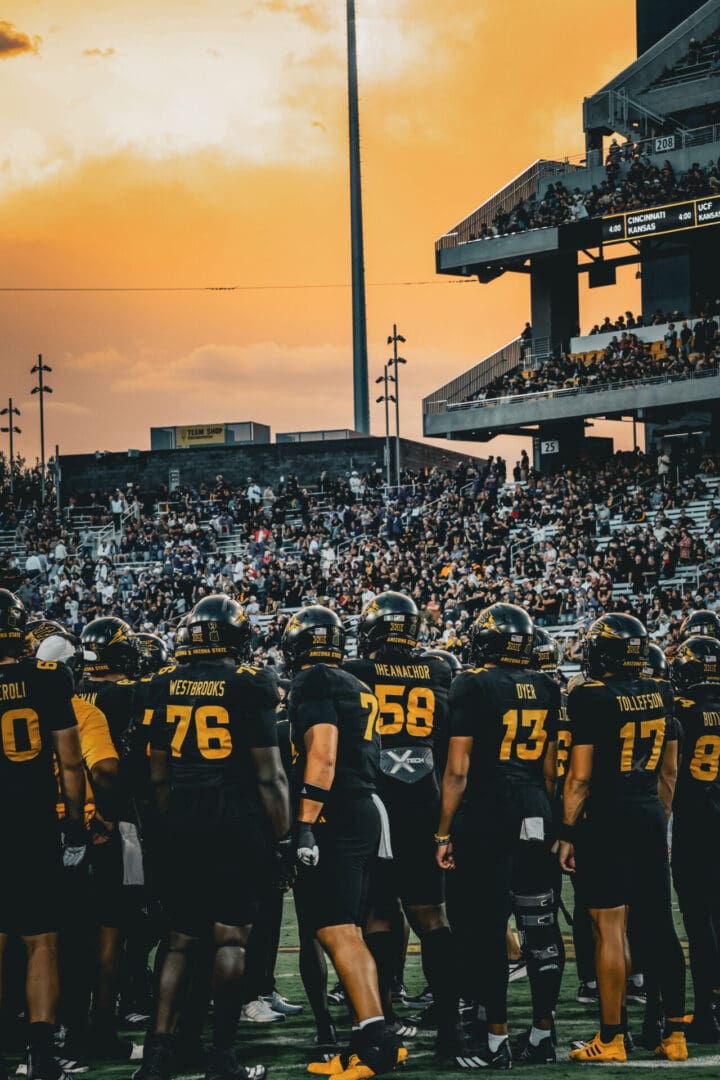
Is the Sleeping Giant Finally Starting to Wake Up at Arizona State?
The money is finally starting to flow into Arizona State Sun Devils football—and if you’re paying attention, it’s not just incremental growth. It’s the kind of financial momentum that can fundamentally reshape a program. The real question isn’t whether Arizona State is improving. It’s whether this influx of resources is enough to turn ASU into a true national powerhouse.
The answer? It absolutely can—but only if the program capitalizes on this moment correctly.
Start with the most obvious shift: facilities. In modern college football, elite infrastructure is no longer a luxury—it’s the price of admission. Under head coach Kenny Dillingham, ASU has aggressively pushed for upgrades, and the results are already showing. A massive new indoor practice facility—funded in part by a major donor—is on the way, giving the Sun Devils one of the most modern training environments in the country.
Pair that with a broader $130+ million athletic investment plan, and suddenly ASU isn’t playing catch-up anymore—it’s building like a contender.
Facilities matter because recruits notice everything. When a five-star prospect walks into a program that looks like it’s investing at an SEC level, perception changes instantly. Arizona State is beginning to close the “wow factor” gap that has historically separated it from blue-blood programs.
But facilities alone don’t build powerhouses—money in the NIL era does.
This is where ASU’s ceiling becomes fascinating. The Sun Devils have already seen NIL opportunities spike following on-field success, particularly after their Big 12 title run and College Football Playoff appearance. That success created a feedback loop: win games, gain exposure, attract money, repeat.
However, here’s the reality check—ASU is still only middle-of-the-pack in NIL spending within the Big 12.
That’s both a warning and an opportunity.

If Arizona State merely stays “middle tier” financially, it won’t become a national powerhouse. It’ll become a solid, competitive program that occasionally breaks through. But if the Valley’s donor base—corporate money, alumni wealth, and the massive Phoenix market—fully engages, ASU could explode into the top tier almost overnight.
Because unlike many schools, ASU isn’t limited by geography or market size. Phoenix is one of the largest metro areas in the country, and the program already generates nearly $100 million in economic impact through athletics.
That’s not a small-school profile. That’s a sleeping giant.
And that phrase—sleeping giant—isn’t just hype. It’s structural reality. Arizona State has:
- A massive alumni base
- A top-5 media market in Phoenix
- Growing Big 12 visibility
- A young, aggressive head coach
- Increasing NIL infrastructure through collectives and partnerships
That combination is rare. Most programs lack at least one of those pillars. ASU has all of them—it just hasn’t aligned them at the same time until now.
The recent success under Dillingham suggests that alignment may finally be happening. A Big 12 championship and College Football Playoff appearance aren’t flukes—they’re proof of concept.
Money amplifies success. And success attracts more money.
That’s how powerhouses are built.
Look at programs like Oregon or Texas A&M over the past decade. They weren’t traditional blue bloods, but massive financial investment—facilities, NIL, branding—allowed them to recruit at elite levels. Arizona State is now entering that same phase.
But here’s the critical caveat: money doesn’t guarantee dominance. It only creates the opportunity for it.
For ASU to truly become a national powerhouse, three things must happen:
First, NIL funding must scale into the top tier of college football. Being “middle of the Big 12” isn’t enough when you’re competing nationally against SEC and Big Ten giants.
Second, recruiting pipelines must expand. The Valley is rich with talent, but ASU needs to win battles in Texas, California, and nationally—and that requires sustained financial commitment.
Third, consistency must follow. One great season sparks momentum. Multiple great seasons build a brand. Powerhouses aren’t defined by peaks—they’re defined by expectations.
Right now, Arizona State is at the tipping point between relevance and dominance.
The money is coming. The facilities are coming. The exposure is growing.
If the financial surge continues—and more importantly, if it accelerates—there is no structural reason ASU can’t become a national powerhouse. In fact, the more accurate statement might be this:
Arizona State isn’t trying to become a powerhouse anymore.
It’s trying to prove it belongs there—and for the first time in decades, the resources are finally backing it up.
Michael J. Wilson-The Daily Waiver
Email: Dailywaiver@gmail.com Instagram: @Dailywaiver Tik-Tok: @Dailywaiver