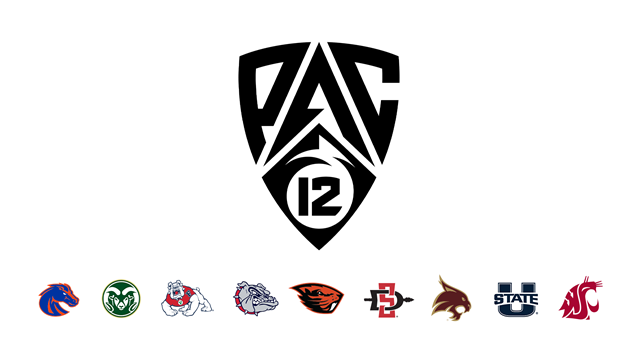
Pac-12 and Mountain West Conference Settle, Now The Work Begins
After nearly two years of lawsuits, accusations, legal filings and conference realignment drama, the Pac-12 Conference and the Mountain West Conference have finally done what college athletics needed them to do—they settled.
The agreement officially ends litigation involving the Pac-12, the Mountain West and the five departing schools heading to the rebuilt Pac-12. While the financial terms remain confidential, the biggest winner may not be either conference. The real winner is stability.
The joint statement released by the parties emphasized exactly that.
“The conferences and institutions can move forward with certainty and focus on serving their student-athletes, campuses, fans and communities.”
That should have been the priority from the beginning.
Pac-12 Credit
For nearly two years, every discussion surrounding the Pac-12 seemed to include court dates, discovery hearings, exit fees or so-called “poaching penalties.” Instead of talking about football schedules, basketball rivalries or television opportunities, the conversation centered on attorneys and judges.
Now that chapter is over.
Pac-12 Commissioner Teresa Gould deserves credit for seeing this process through. Ever since taking over leadership of the conference, her message has consistently been about rebuilding the Pac-12 into a sustainable western conference instead of trying to recreate the league’s past overnight.
This settlement gives her exactly what she needs—certainty.
Instead of worrying about legal expenses and courtroom strategy, Gould can devote her attention toward improving the conference’s television exposure, growing revenue and strengthening relationships among member institutions.
The Pac-12 now has the opportunity to establish its new identity with Oregon State, Washington State, Boise State, Fresno State, Colorado State, San Diego State, Utah State, Gonzaga in basketball and Texas State joining the league. That is a solid foundation, but success will ultimately be determined on the field and in television ratings—not in legal filings.
Mountain West Credit
The Mountain West, meanwhile, deserves recognition for avoiding an even longer legal battle that could have become even more expensive.

Commissioner Gloria Nevarez had repeatedly maintained that the conference would protect the interests of its remaining members throughout the litigation. While the conference undoubtedly would have preferred collecting every dollar it originally sought, litigation is unpredictable, expensive and time-consuming.
Settling allows the Mountain West to move forward with its own rebuilt membership, including UTEP, Hawaii and Northern Illinois in football, rather than remaining trapped in the past.
Neither conference can afford to spend another year looking backward.
College athletics has changed too rapidly.
Moving Forward
Revenue sharing, NIL, the House settlement, conference television negotiations and the constantly evolving College Football Playoff demand full attention from conference commissioners.
Legal battles don’t generate television ratings.
Winning football games does.
Growing basketball brands does.
Creating compelling media inventory does.

Perhaps the biggest takeaway from this settlement is that conference realignment has entered a different phase.
For years, expansion was about survival.
Today, it is increasingly about maximizing media value.
The Pac-12 has survived.
Now it has to prove it belongs alongside the nation’s major conferences.
That challenge begins immediately this fall.
The rebuilt league has legitimate football brands led by Boise State, Oregon State, Washington State and San Diego State, while Gonzaga instantly elevates men’s basketball. Those are meaningful additions, but the conference still has to convince television partners and recruits that the new Pac-12 represents long-term stability.
This settlement removes one obstacle toward achieving that goal.
College athletics analyst John Canzano noted throughout the process that both conferences ultimately had strong incentives to avoid taking the dispute all the way through trial because of the uncertainty, legal costs and business distractions involved. That assessment appears to have proven accurate with the final agreement.
Analysts have also pointed out that confidential settlements frequently allow both sides to claim partial victories while avoiding the risk of a courtroom loss.
That seems to be exactly what happened here.
The Pac-12 avoided the possibility of paying significantly larger penalties if it lost.
The Mountain West secured compensation without risking an adverse legal ruling that could have weakened future conference agreements.
Sometimes there are no clear winners.
Only practical outcomes.
There is also an important lesson for the rest of college athletics.
Conference realignment has become increasingly hostile over the past several years.
Schools sue conferences.
Conferences sue schools.
Former partners become courtroom opponents.
Eventually, everyone discovers that litigation costs millions while producing very little value for student-athletes or fans.
Hopefully this settlement encourages future conference disputes to reach negotiated solutions much earlier.
Nobody buys football tickets because of successful legal motions.
Fans care about kickoff.
They care about championships.
They care about rivalries.
Those are the products conferences actually sell.
Opportunities For The Conferences
The Pac-12 now has a chance to write a completely different story than the one that followed its near-collapse in 2023. Instead of being remembered for losing ten members, it can begin building a reputation for resilience and smart growth.
The Mountain West has an opportunity to prove it remains one of the strongest Group of Five conferences despite significant membership turnover.
Both conferences have plenty to prove.
But at least now they’ll be doing it where they belong—on football fields, basketball courts and television broadcasts instead of inside federal courtrooms.
For everyone involved in western college athletics, that’s progress.
Michael J. Wilson-The Daily Waiver
Email: Dailywaiver@gmail.com Instagram: @Dailywaiver Tik-Tok: @Dailywaiver