
The Automated Ball-Strike System is a Positive for MLB
The introduction of the Automated Ball-Strike (ABS) challenge system in Major League Baseball represents one of the most significant rule changes in the sport’s modern era. While traditionalists may initially resist the idea of technology influencing the strike zone, the new “challenge the pitch” system is ultimately a positive development for baseball. By improving accuracy, preserving the human element, increasing strategy, and enhancing fan engagement, the ABS challenge system strikes the perfect balance between innovation and tradition.
Why it was implemented
At its core, the ABS challenge system is about getting calls right. For decades, arguments over balls and strikes have been one of baseball’s most persistent frustrations. Missed calls—especially in high-leverage moments—can alter the outcome of games and even seasons. The new system directly addresses this issue by allowing players to challenge questionable calls in real time. According to league data from early testing, only a small percentage of pitches are challenged, yet more than half of those challenges result in overturned calls, highlighting how impactful even limited corrections can be.
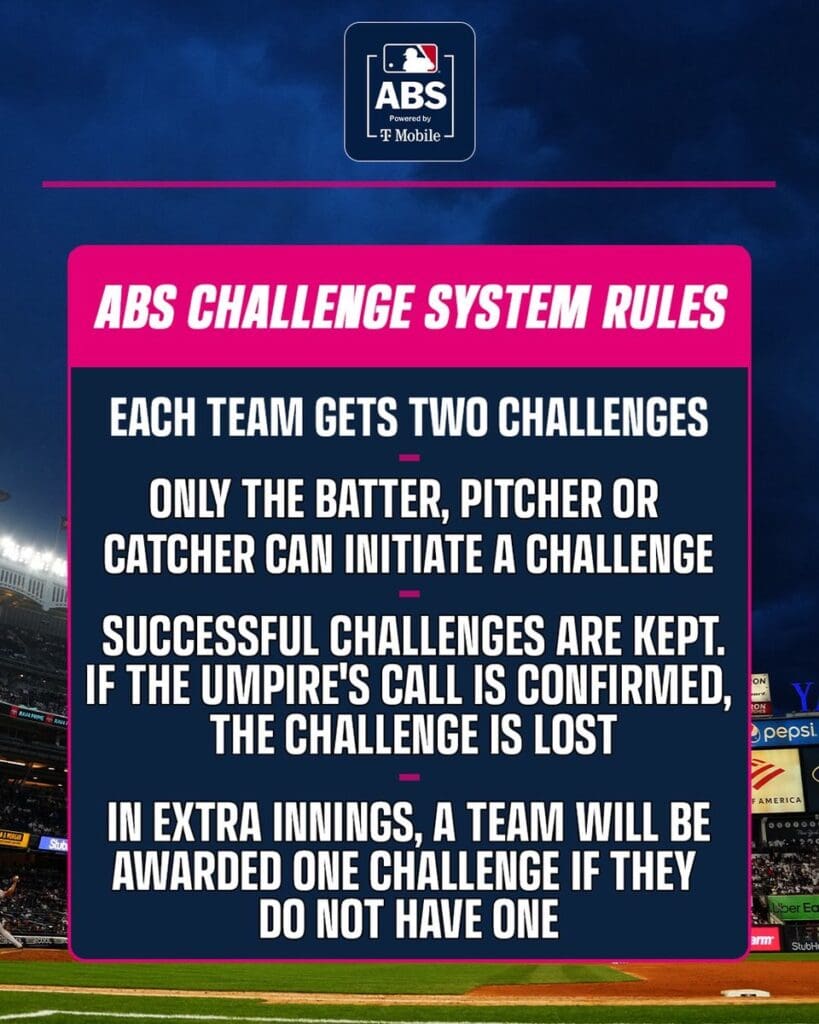
Commissioner Rob Manfred has emphasized that this system is part of a broader effort to modernize the game without losing its essence. In a league statement, he explained that MLB worked “at every step to make the game better” while ensuring the system remained “acceptable to players.” That balance is crucial. Unlike a fully automated strike zone—often referred to as “robot umpires”—the challenge system keeps human umpires in control while providing a safety net for clear mistakes.
Hybrid Approach
This hybrid approach is one of the system’s greatest strengths. Baseball has always valued its human element, including the subtle art of pitch framing and the individuality of umpire strike zones. A fully automated system would erase those nuances entirely. Instead, the challenge model allows the game to retain its traditional feel while eliminating the most egregious errors. As one report noted, the system is designed as a “middle ground” between full automation and traditional umpiring.
Players themselves are already beginning to embrace the change. During spring training and early regular-season games, many have expressed confidence in the system’s fairness and strategic value. Patrick Bailey, a standout defensive catcher, acknowledged that while the adjustment takes time, the system can create “opportunities to gain an edge” and will likely be used selectively rather than excessively. This reflects a broader sentiment among players: the system isn’t disruptive—it’s a tool.
A New Strategy
That tool introduces a fascinating new layer of strategy. Each team is limited to a small number of challenges per game, meaning players must be selective about when to use them. A borderline pitch early in the game might not be worth the risk, but a crucial call in the ninth inning could be. Managers and players must now think critically about probability, game situation, and confidence in their judgment. This added dimension enhances the intellectual side of baseball, making it even more engaging for both participants and fans.
New York Yankees infielder José Caballero made history by initiating the first ABS challenge in a regular-season game. Even though his challenge was unsuccessful, the moment demonstrated how seamlessly the system can be integrated into gameplay. Managers like Aaron Boone have already encouraged players to use the system aggressively when appropriate, reinforcing the idea that this is a strategic weapon rather than a gimmick.

Increased Fan Engagement
Beyond fairness and strategy, the ABS challenge system also enhances the fan experience. One of baseball’s ongoing challenges in the modern sports landscape is maintaining engagement in an era of instant replay and data-driven analysis. Fans watching at home often have access to strike-zone graphics that reveal missed calls immediately, creating frustration when those calls cannot be corrected. The challenge system bridges that gap, aligning what fans see with what is enforced on the field.
Additionally, the quick resolution of challenges—typically taking around 15 seconds—ensures that the pace of play is not significantly disrupted. This is critical in a league that has already taken steps to speed up games with the pitch clock and other rule changes. Rather than slowing the game down, the ABS system fits neatly into MLB’s broader modernization efforts.
Critics argue that introducing technology into ball-strike calls could diminish the role of umpires or lead to over-reliance on machines. However, early evidence suggests otherwise. The limited number of challenges prevents overuse, and umpires still make the vast majority of calls. In fact, the system may even increase respect for umpires by reducing the number of controversial, game-altering mistakes that lead to heated arguments and ejections.
Final Thoughts
Ultimately, the ABS challenge system represents a thoughtful evolution of baseball. It acknowledges the imperfections of human officiating while respecting the traditions that make the sport unique. By empowering players, improving accuracy, and adding strategic depth, MLB has found a way to modernize without compromising its identity.
In a sport often resistant to change, this is exactly the kind of innovation that moves the game forward.
Michael J. Wilson-The Daily Waiver
Email: dailywaiver@gmail.com Instagram: @dailywaiver Tik-Tok: @dailywaiver